How to Get Rid of Ants in the Kitchen (and When to Call a Pro)
Reviewed by The Small Crew editorial team against university extension sources (UC IPM, UF/IFAS, NPMA).
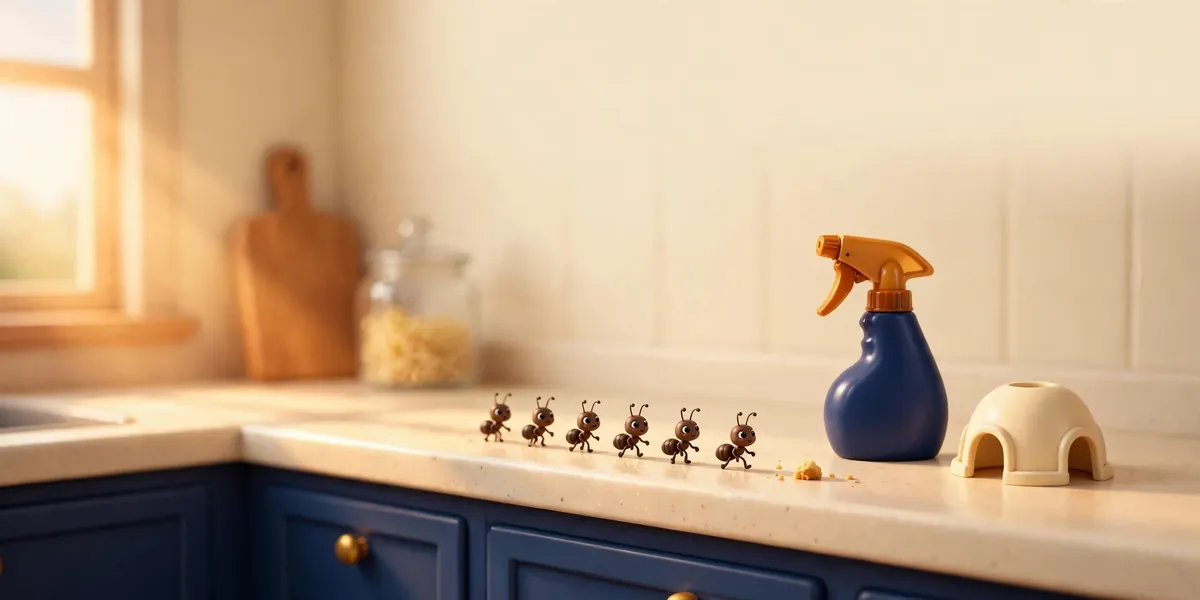
Small ants marching across the counter are one of the most common household pest problems. Most of the time you can do the work yourself in an afternoon — though bait can take 5 to 10 days to show results. Here's a step-by-step plan based on university extension research, plus clear signs that it's time to call a professional.
According to the National Pest Management Association, ants are the number-one nuisance pest in the United States. [13]
The 3-question helper below turns the steps in this article into a short plan for your situation.
The short answer
- Follow the trail to see what the ants want and where they get in.
- Clean up the food, crumbs and spills, and wipe the trail away.
- Seal the gaps they're using to get inside.
- Use slow-acting ant bait instead of spray, and give it time to work.
- Call a licensed pro if the ants are nesting inside walls, or keep coming back.
Why spraying the ants you can see doesn't solve it
The ants on your counter are only the foragers. The colony, including the queens, usually lives outside or hidden in a wall or under the floor. University of California researchers note that sprays only knock ants back for a while and may not be safe to use indoors. Killing the foragers you can see doesn't stop more from coming in, because most of these ants nest outside. [1][2]
That's why the steps below focus on three things: taking away what they came for, closing the door, and getting the colony itself.
Step 1: Find out what they're after
Watch the trail for a few minutes. Ants follow a scent path between their nest and a food or water source, so the line usually leads straight to the problem: a sticky spot, a crumb pile, the pet bowl or the trash. Follow it the other way too, to find where they come in — often a crack along a window, a gap behind the sink, or where a pipe enters the wall. [1][6]
Step 2: Clean up, and wipe out the trail
- Wipe up spills and crumbs, especially anything sugary or greasy. [3]
- Move food into containers with tight-fitting lids. [2]
- Pick up pet food bowls when your pet isn't eating. [6]
- Empty the kitchen trash more often while you deal with the ants.
- Wipe up the ants on the trail with soapy water rather than reaching for a spray. [2]
Ants navigate by a pheromone trail — a scent path laid down by scout ants. Wiping the trail with soapy water breaks that path and slows new arrivals. [2][4]
University of Florida entomologists call cleanliness the best approach to ant control in the home. [4]
Step 3: Seal the way in
Use caulk to close cracks and gaps where the ants are entering — around window frames, baseboards, faucets and pipes. Some small ants can squeeze through extremely small openings, so check carefully. Sealing gaps also helps keep other insects out. [1][4]
Step 4: Use bait, not spray
Ant baits mix food the ants want with a slow-acting insecticide. Worker ants carry it back and share it, which lets it reach the rest of the colony, including the queens. It has to act slowly so the workers survive long enough to get home. [2]
- Choose enclosed bait stations where you can. Prepackaged or refillable stations are the safest option around the home. [9]
- Put baits next to the trail and near where the ants come in, indoors and out. [3][5]
- Keep baits away from children and pets. [5]
- Don't spray near the bait. You want the ants to keep visiting it and carrying it home.
- Be patient. It can take 5 to 10 days to see fewer ants, and longer for the colony to decline — don't move the bait once ants are feeding on it. [2]
Bait alone usually isn't enough for some common species, so keep up the cleaning and sealing at the same time. [10]
Step 5: Stop the next invasion
- Keep plants, grass, and mulch at least a foot away from the foundation of the house, and keep the area clear of leaves and debris, so ants have fewer places to nest right next to your walls. [2]
- Trim branches and shrubs that touch the house; they act like bridges.
- If ants come in at the same time every year, caulk and set bait a little before that time comes around. [1]
When to call a professional
Do-it-yourself steps handle most kitchen ant problems. Call a pest professional when:
- The ants are nesting inside your walls or under floors. Treating wall voids and indoor nests may need a professional. [3]
- You think you have carpenter ants. Florida carpenter ants don't eat wood, but they do nest inside walls, attics and soft or rotting wood, and a colony inside the house is worth having a professional find and treat. [11]
- The numbers are overwhelming, or the problem keeps coming back after you've cleaned, sealed and baited.
- The trail comes back within two weeks of treatment (that means the nest was not reached), or the problem persists after about four weeks of consistent treatment.
What to ask for: UC researchers suggest asking the company to use baits and spot treatments rather than perimeter treatments or monthly sprays. [2]
In Florida, anyone doing pest control for hire must be licensed by the Florida Department of Agriculture and Consumer Services (FDACS). Ask for the license and check it before you hire. [12]
Our free contractor directory is opening soon. You'll be able to find licensed pest professionals near you.
Back to the homepageWhat you'll need
You don't need much. These are the kinds of items the steps above use. We list categories, not brands:
| What it is | What it does | What to look for |
|---|---|---|
| Enclosed ant bait stations (borax-based) | Let worker ants carry slow-acting bait back to the colony | Choose one whose label lists the ants and places you're treating. Enclosed, tamper-resistant stations are safer than open trays around children and pets. Don't spray repellent near them. |
| Gel ant bait | Bait for cracks and crevices | A tube or syringe. Don't spray near it. |
| Food-grade diatomaceous earth | A thin barrier at entry points | Food-grade, not pool-grade. Dry areas only; it stops working when wet. |
| Silicone or acrylic caulk and a caulking gun | Sealing cracks and gaps | For windows, baseboards, faucets and pipes. |
| Airtight food storage containers | Keeping food away from ants | With tight-fitting lids. |
Sources
- Pest Notes: Ants (Publication 7411) — University of California Statewide IPM Program.
- Quick Tips: Ants — UC Statewide IPM Program (also the 2024 PDF edition).
- Odorous house ant — management tips — UC IPM Key to Identifying Common Household Ants.
- Ants (ENY203) — Koehler, Vazquez & Pereira, UF/IFAS Extension, revised 2022, reviewed 2025.
- Odorous house ant — baits — UC IPM.
- Tawny Crazy Ant — general management — UF/IFAS Extension.
- Pesticide Safety: The Label is the Law — UF/IFAS Gardening Solutions.
- EPA Explains: How to Read a Pesticide Product Label — US Environmental Protection Agency.
- Quick Tips: Ants (PDF) — UC Statewide IPM Program.
- Argentine ant — baits — UC IPM.
- Florida Carpenter Ants (IN1075) — UF/IFAS Extension, reviewed 2025.
- Licensing of Structural Pesticide Applicators in Florida (Chapter 482, F.S.) — UF/IFAS EDIS (archival copy), and FDACS Pest Control Licensing and Certification.
- Ants 101 — National Pest Management Association (PestWorld.org), updated 2024.
Keep reading
 Verified
How to Get Rid of Cockroaches in Your Kitchen (and Keep Them Out)
Find where they hide with sticky traps, take away food and water, seal the gaps, then bait — baits work better than sprays, and foggers make things worse. Based on University of California IPM guidance.
 Verified
How to Clean Your Refrigerator (and Keep Your Food Safe)
Empty it and sort it, wash with hot, soapy water, sanitize with a weak bleach solution, and put food back where it stays coldest — the CDC's 5-step method, plus the 40°F check. Based on CDC, USDA, Penn State and Iowa State Extension guidance.
 Verified
How to Clean Mold and Mildew in Your Bathroom (and Keep It From Coming Back)
Moisture first, scrubbing second: check the size, protect yourself, fix the leak, scrub with detergent and water, and keep it from coming back. Based on EPA, CDC, and NC State Extension guidance.